

Research Perspectives
RESEARCH PERSPECTIVE
The Valley of Death and Capital Continuity
Promising technologies frequently struggle to secure the continuing capital required to progress from research toward market application. The “valley of death” reflects not only a funding gap, but a coordination challenge across maturity, compatibility, participation, and capital continuity as innovation advances through stages of development.
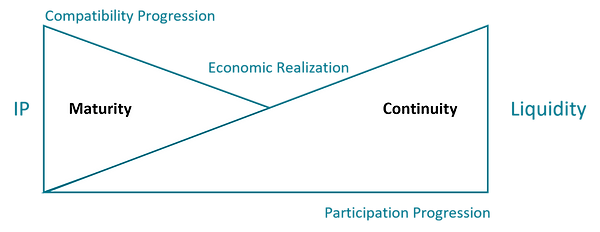
From an Innovation Capital Formation perspective, however, the valley is not only a funding gap. It is also a coordination problem between innovation that is still forming and the changing conditions under which different participants and forms of capital can engage.
As knowledge and invention progress, their characteristics become increasingly defined. Technical maturity develops. Potential applications become clearer. Information accumulates. Risks change. Resource requirements expand. Intellectual property, development relationships, and potential markets may become more established.
Capital develops under different conditions. Public research funding, grants, venture capital, strategic corporate investment, private capital, and increasingly institutional forms of capital operate according to different mandates, maturity requirements, risk tolerances, information needs, governance expectations, and participation horizons.
The challenge is therefore not simply whether capital exists. It is whether innovation and appropriate forms of capital can become sufficiently compatible at the stages when continued development requires them to interact.
The valley of death can be understood as a point of discontinuity where the conditions produced through innovation development and the conditions required for subsequent participation are insufficiently aligned.
This changes the nature of the problem.
Providing additional financing may extend a particular development program, but financing alone does not necessarily create the conditions for continued participation. Sustained progression also depends upon whether innovation becomes sufficiently legible and verifiable, whether relevant participants and resources can be discovered, whether information can move across institutional boundaries, and whether subsequent forms of capital can evaluate and participate according to their own requirements.
From this perspective, crossing the valley is not necessarily one financing event. It is a process through which maturity, information, compatibility, participation, and capital can progressively align as innovation develops.
Different participants may therefore enter and leave at different stages. Early research funding can support scientific or technical development without being expected to finance commercialization. Venture investors may participate under one set of maturity and risk conditions, while strategic corporations or later-stage capital participate under another.
Capital continuity does not require participant continuity.
It requires credible pathways through which participation can transition as innovation matures and its requirements change. This is where economic architecture becomes important. Shared standards, structured information, interoperability, verification, and clearer participation conditions can reduce the need to reconstruct an innovation and its context each time it encounters a new institution or potential source of capital.
Development can generate information that supports subsequent participation, while participation itself can contribute additional information, relationships, resources, and signals as innovation progresses.
The objective is not to eliminate development risk or ensure that every promising technology receives continued financing. Some technologies will prove technically unsuccessful, economically unattractive, or incompatible with subsequent participation.
The architectural question is different:
Can innovation that warrants continued development remain connected to appropriate resources and forms of capital as the conditions for participation change?
Innovation Capital Formation examines the valley of death through this broader lens. Rather than treating the problem only as an absence of funding, it examines the economic architecture through which innovation formation and capital formation can become progressively compatible—creating greater continuity between research, development, participation, and economic realization.
Research Guide No. 01 ↗ provides a concise introduction to Innovation Capital Formation and the framework through which maturity, compatibility, participation, and continuity are examined as interdependent conditions of economic translation.
Research Context
This Perspective applies the Innovation Capital Formation framework presented in Research Guide No. 01 ↗ to the widely recognized “valley of death” problem in innovation development. The framework draws upon foundational research developed across the IPX Foundation's published Research Papers and broader architectural research program.
Innovation Capital Formation research has developed over multiple years across economic, market, system, liquidity, financial, institutional, and organizational dimensions, forming an architectural knowledge base that includes integrated System Architecture, conceptual and semantic structures, architectural models and representations, and related research and design work.
Applied to the valley of death, this architecture provides a framework for examining how changing conditions of innovation development interact with the requirements of different participants and forms of capital. Maturity, information, compatibility, participation, and continuity can therefore be considered as interdependent conditions rather than as separate financing problems.
Published Research Papers progressively examine and further develop dimensions of this architecture. Participatory Research Studies provide a framework for institutional and multidisciplinary examination, further architectural development, and preparation toward contemplated subsequent development of shared coordination infrastructure.
Continue Reading
Research Architecture ↗
Research Approach ↗
Research Guides ↗